
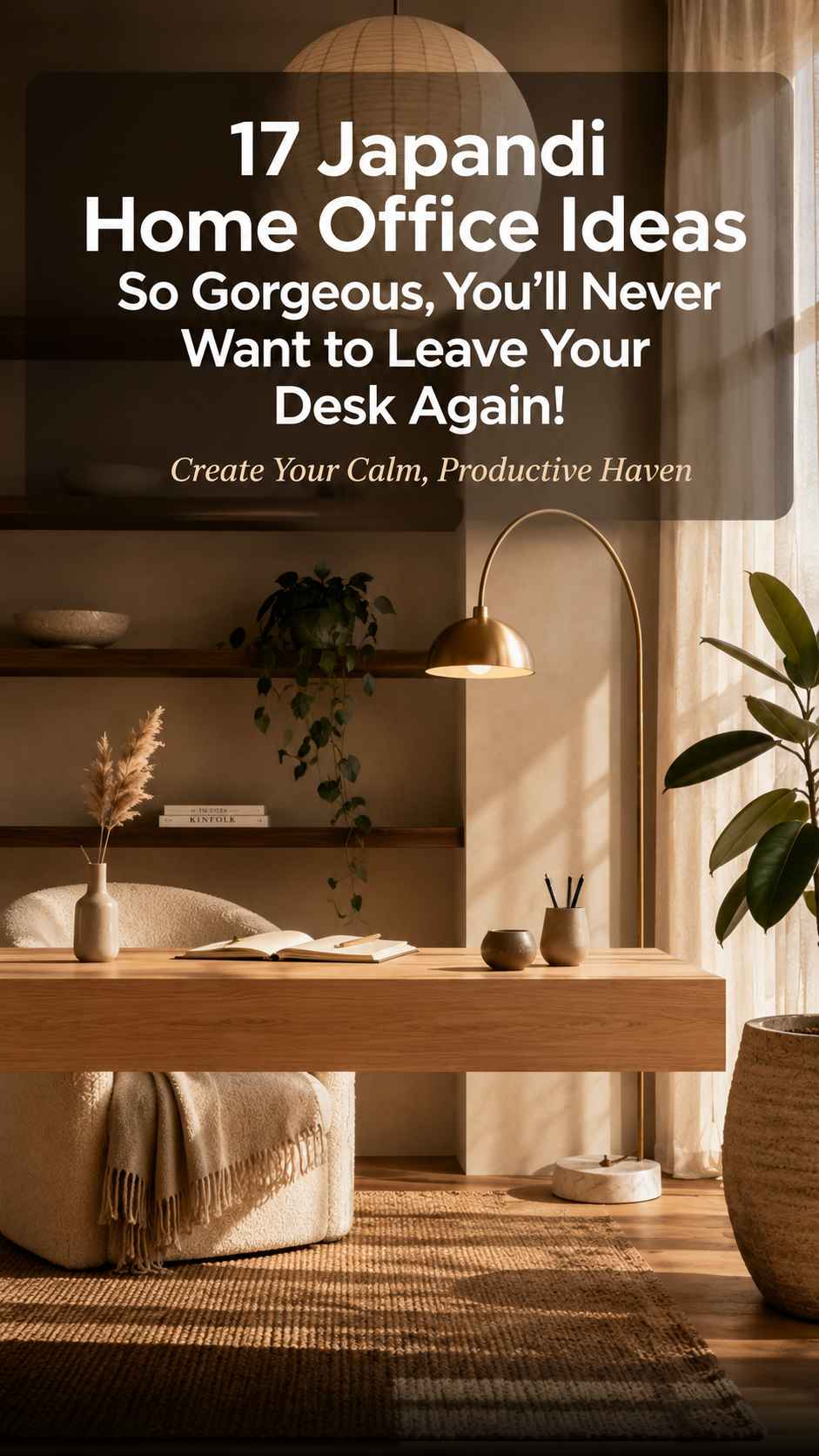
There’s a specific kind of stress that creeps in when your workspace feels cluttered, cold, or just completely uninspiring. You sit down to work and instead of flowing into focus, your brain immediately starts scanning the chaos around you. Sound familiar? If you’ve been searching for a way to make your home office feel like an actual haven, the japandi home office aesthetic might just be the answer you didn’t know you were looking for. It blends the warmth of Japanese wabi-sabi with the clean functionality of Scandinavian design — and the result is something almost meditative. Let’s explore 17 gorgeous, practical ideas to get you there.
1. The White Oak Floating Desk Setup
If there’s one single investment that can completely transform how your japandi home office feels, it’s a floating white oak desk. Nothing grounds a space quite like the warm, golden grain of solid wood mounted cleanly to a wall — no chunky legs, no visual clutter interrupting the floor, just pure intentional simplicity. The moment you install one, the room exhales. You get a workspace that feels both luxurious and utterly calm at the same time.
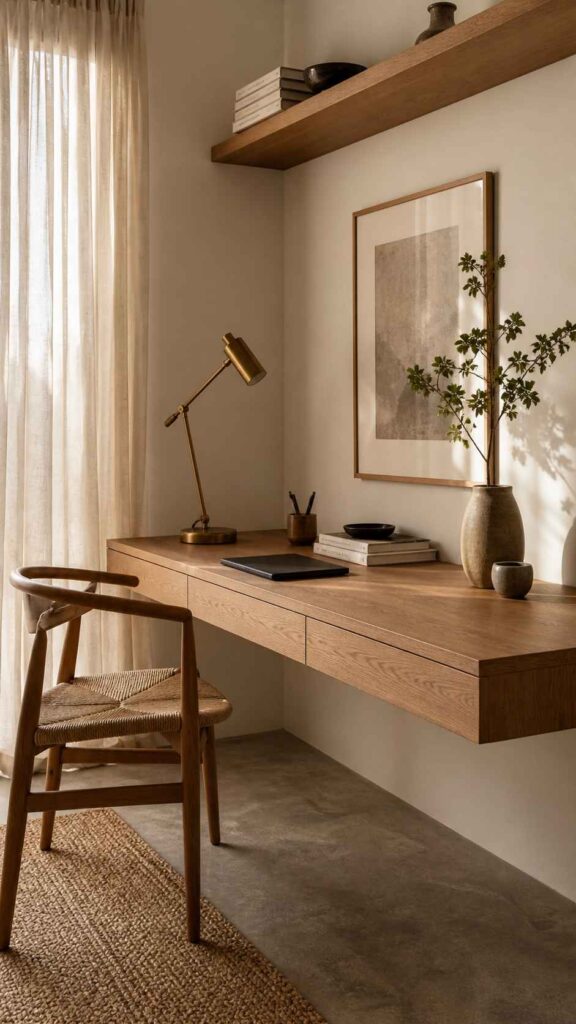
Elements:
- Choose solid white oak or ash over veneers for authentic grain and warmth
- Mount at the correct ergonomic height: approximately 71–76 cm from floor
- Pair with a matte steel or raw brass wall bracket for visual contrast
- Keep the desk surface minimal — one lamp, one plant, one notebook
- Use hidden cable routing channels along the wall behind the mount
Description: The white oak floating desk is the undisputed anchor piece of any serious japandi home office. Its power comes from what it removes — the visual weight of legs, the clutter of feet-level furniture — creating a room that feels immediately wider and more breathable. Style it with a single ceramic mug for pens, a low-profile brass task lamp, and one small sculptural plant in a raw stone pot. Keep the desktop 80% clear. That emptiness is not wasteful — it’s intentional, and it’s where your best thinking happens.
Pro Tip: When sourcing a white oak desk, avoid pre-finished options with high-gloss polyurethane coatings. Instead, ask for a natural oil or matte wax finish. This keeps the wood tactile, warm, and authentically wabi-sabi as it gradually deepens in colour with age — making your desk more beautiful, not less, with every passing year.
2. Wabi-Sabi Wall Shelf Gallery
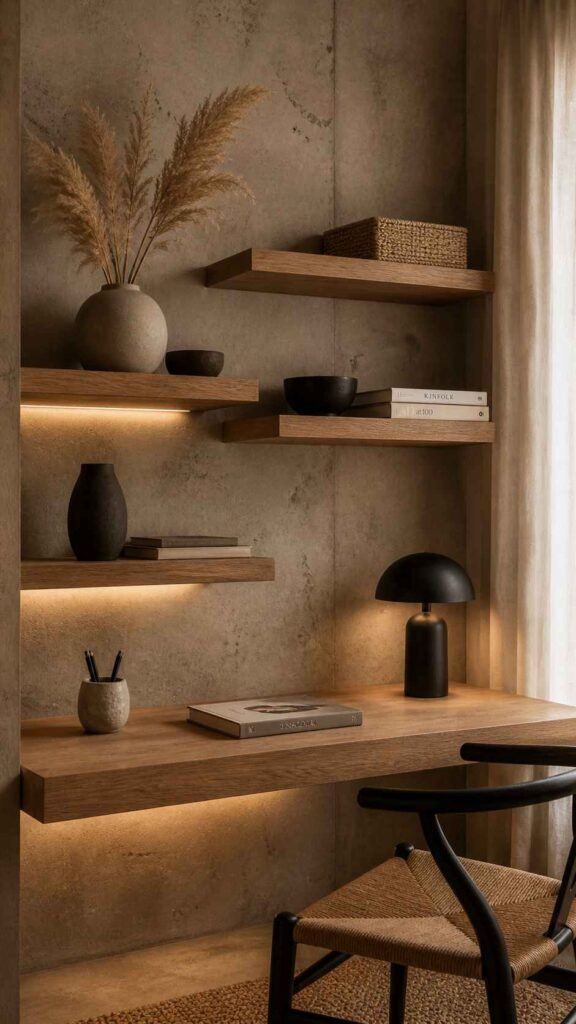
One of the most distinctly Japanese elements you can bring into a japandi home office is a thoughtfully curated wall shelf arrangement — but here’s the key word: thoughtfully. This isn’t about filling every inch of wall space. It’s about choosing three to five objects that each have meaning, texture, or sculptural beauty and letting them breathe. A rough-edged ceramic bowl, a single design book, a small dried branch in a minimal vase — the imperfection is the entire point.
Practical Elements:
- Limit displayed objects to a maximum of five per shelf for breathing room
- Mix textures: smooth ceramic next to rough rattan next to matte wood
- Incorporate dried botanicals (pampas grass, eucalyptus, cotton stems) for organic warmth
- Use floating shelves in matching wood tone as your desk for cohesion
- Leave deliberate empty space — negative space is part of the composition
Description: The wabi-sabi wall shelf gallery is your opportunity to introduce storytelling into your japandi home office without adding clutter. Each object on those shelves should pass a simple test: does it have beauty, function, or meaning? If not, it doesn’t earn its place. A handmade ceramic tumbler glazed in warm stone tones, a single architectural succulent, and one beautiful spine-out book are more visually powerful than fifteen random knick-knacks fighting for attention. This is curation, not decoration.
Pro Tip: Before placing items on your wall shelves, lay them out on the floor first and photograph them from standing height. You’ll immediately see which objects create visual harmony and which ones feel out of place. This low-stakes rehearsal saves you from drilling unnecessary holes and helps you nail the composition on the very first try.
3. The Zen Corner Nook
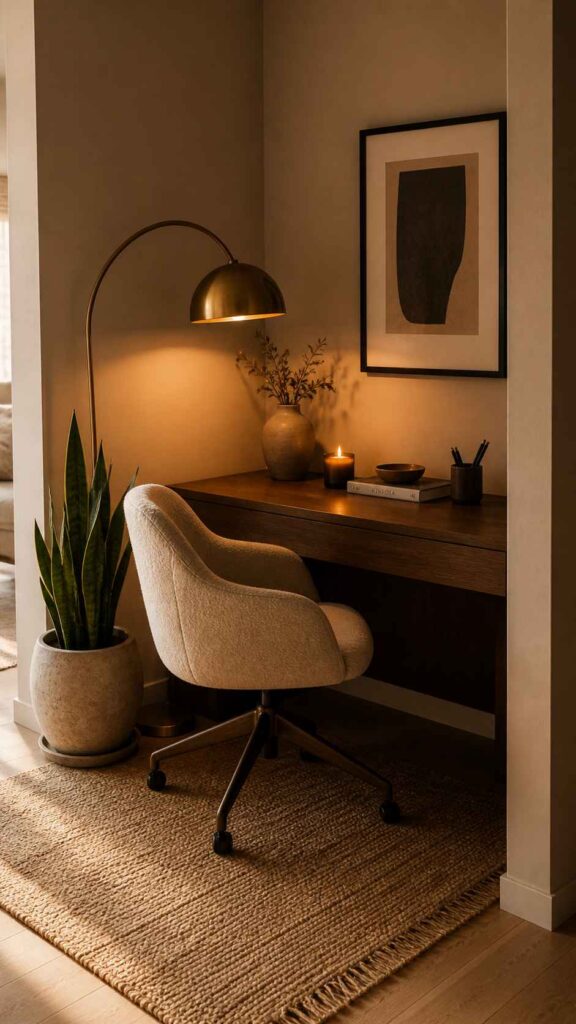
Not everyone has a dedicated home office room — and honestly, a carved-out corner done right can be even more atmospheric than a full room. A japandi home office corner nook uses boundaries cleverly: a beautifully textured wall, a compact wooden desk angled into the corner, warm pooling light from a floor lamp, and a woven rug beneath your feet. It feels enclosed in the best possible way — like a private thinking space within a larger room.
Practical Elements:
- Define the corner with a low-profile woven rug to anchor the workspace visually
- Use an arc floor lamp to eliminate the need for overhead lighting
- Choose a compact desk (under 120 cm wide) with clean tapered wooden legs
- Add a single tall architectural plant (snake plant, monstera) to create vertical height
- Use one framed art print in muted tones to close the visual boundary of the nook
Description: The corner nook japandi home office setup is a masterclass in doing more with less square footage. By anchoring the corner with a warm walnut desk, a plush boucle chair, and a generous arc lamp, you create a space that feels genuinely dedicated to deep work — even if it shares a room with a sofa. The psychological power of a defined, cozy corner should not be underestimated. Your brain learns to associate that specific corner with focus, making it easier to drop into a productive mindset the moment you sit down.
Pro Tip: If your corner nook shares space with a living room or bedroom, try hanging a lightweight linen panel from the ceiling on one side to create a soft visual boundary. This simple trick signals “work zone” without any structural changes and adds a beautiful, flowing textile element that’s very much on-brand for japandi sensibility.
4. Layered Japandi Lighting Blueprint
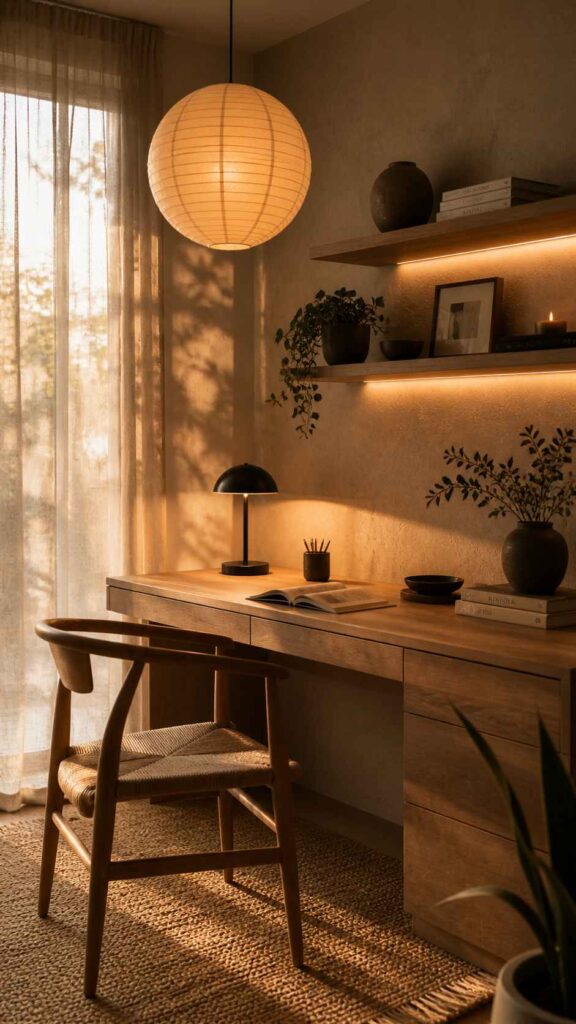
Lighting in a japandi home office is not just functional — it’s architectural. The way you layer warm light sources across a room directly impacts how focused, calm, and creative you feel during long work sessions. The goal is to eliminate harsh overhead fluorescents entirely and replace them with a system of layered warm light: ambient, task, and accent. When done correctly, the room glows rather than bleaches, and that distinction is everything.
Practical Elements:
- Use bulbs in the 2700K–3000K range across all fixtures for circadian-friendly warmth
- Layer three sources minimum: ambient (pendant), task (desk lamp), accent (shelf LED)
- Never place your desk with your back to a window — go perpendicular for soft side light
- A Noguchi-style washi paper pendant eliminates harsh ceiling shadow beautifully
- Dimmer switches on all overhead circuits give you full control of the mood
Description: The layered lighting blueprint is the single most impactful upgrade you can make to a japandi home office that feels flat or clinical. Start with your colour temperature — every bulb in the room should be 2700K or 3000K to cast that warm, late-afternoon glow that makes wood furniture sing and walls feel inviting. Then layer: let a washi paper pendant handle your ambient base, a focused desk lamp handle your task zone, and a low LED shelf strip create depth in your wall storage. The result is a room that shifts between bright-and-focused and warm-and-contemplative with a single dimmer switch.
Pro Tip: Position your task lamp asymmetrically on the desk — off to the side rather than centred behind your monitor. This angled wash of light illuminates your physical notes and keyboard without bouncing glare off your screen. It’s a small positional change with an enormous impact on eye comfort during long creative sessions.
5. Rattan Accents and Earthy Textures
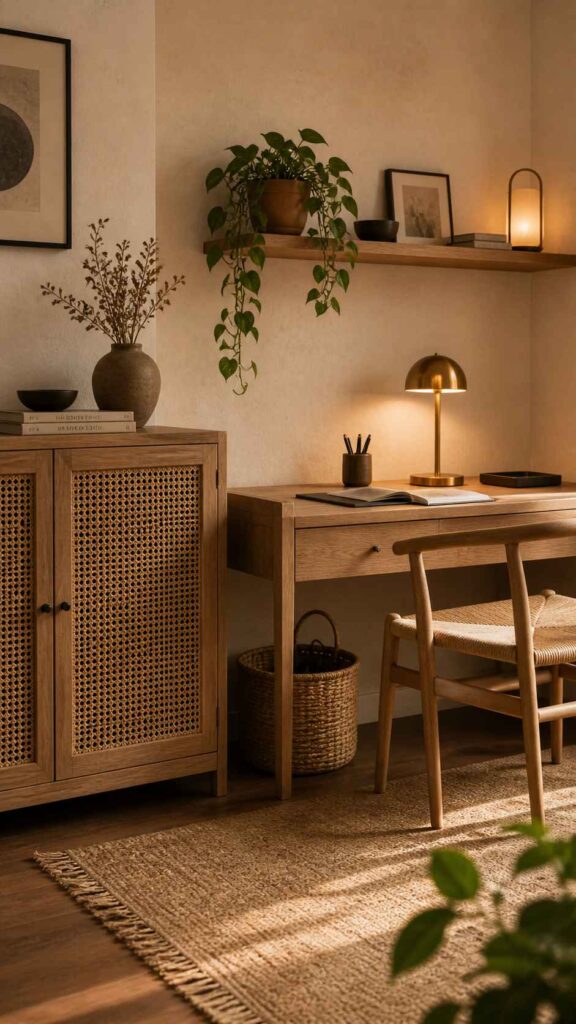
If wabi-sabi teaches us to find beauty in natural imperfection, then rattan is one of its most honest expressions. The open weave, the warm honey-brown tones, the slightly rough-to-the-touch texture — rattan is the material that bridges Japanese rusticity with Scandinavian warmth in the most effortless way. In a japandi home office, even a single rattan element — a basket under the desk, a cabinet door insert, an accent chair — transforms the space from merely minimal to genuinely warm.
Practical Elements:
- Use a rattan-door cabinet for hidden storage that adds texture without visual noise
- Place a woven rattan basket under the desk for tidy cable and accessory storage
- Mix rattan with smooth ceramics and raw wood for a balanced texture palette
- Pair rattan tones with charcoal or deep green accents for sophisticated contrast
- Avoid overdoing it — one or two rattan pieces per space is the ideal maximum
Description: Rattan in a japandi home office is a textural storyteller. Its imperfect, organic weave immediately softens the clean lines of a minimal desk and white walls, adding a layer of rustic warmth that no manufactured material can replicate. Style a rattan cabinet alongside a smooth white oak desk and the contrast in surfaces creates a visual conversation — one smooth, one woven, both natural. Finish with a warm terracotta plant pot, a jute rug underfoot, and the earthiness of the room becomes quietly, beautifully grounding.
Pro Tip: When integrating rattan storage into your japandi home office, look for pieces with solid wood frames and rattan panel inserts rather than all-rattan construction. This gives you the aesthetic warmth of the material while maintaining the structural rigidity needed for a functional filing cabinet or bookshelf — beauty and practicality, perfectly balanced.
6. The Minimalist Bamboo Workspace
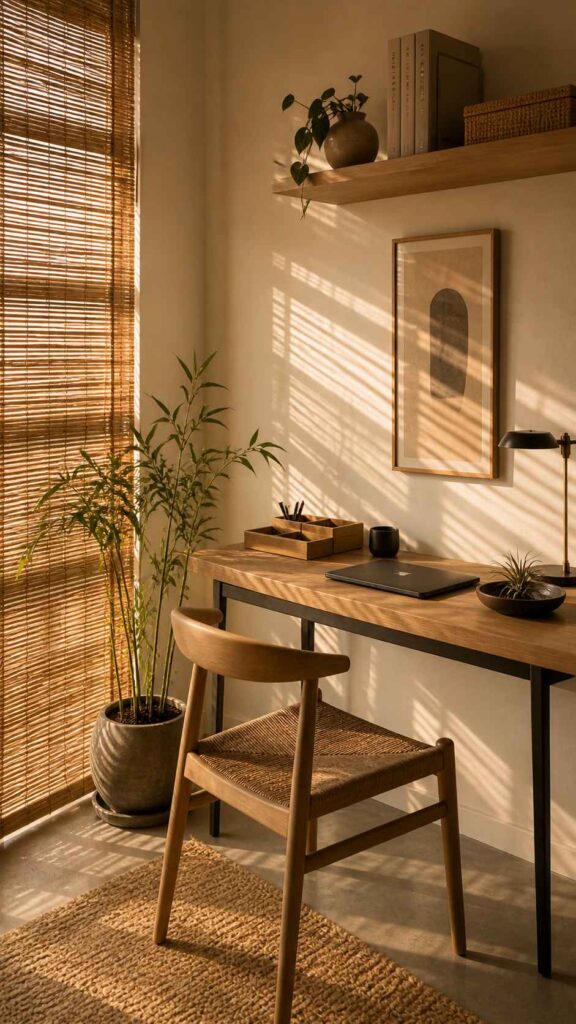
Bamboo is one of the most symbolically and aesthetically significant materials in Japanese design — representing resilience, flexibility, and quiet strength. Bringing bamboo elements into your japandi home office goes beyond aesthetics; it brings a cultural intention into the room. Whether it’s a bamboo desk surface, bamboo window blinds that filter light into warm, honeyed strips, or a bamboo pen tray, every piece adds a layer of authentic Japanese character to the workspace.
Practical Elements:
- Install bamboo roller blinds to filter sunlight into beautifully warm, diffused strips
- Choose a bamboo desk surface (like the IKEA ANFALLARE) for an affordable Japandi-ready option
- Use a bamboo tray as a desk organiser to contain small items with clean visual order
- Pair bamboo with matte black or warm brass metal accents for grounded contrast
- Incorporate a bamboo-framed mirror to expand small spaces and add height
Description: The bamboo-integrated japandi home office carries a quieter energy than any other setup — there’s something about the grass-like warmth of the material that makes a room feel almost meditative. Bamboo blinds in particular are a secret weapon: as light passes through their natural slats, it transforms from ordinary afternoon sun into a warm, layered glow that moves across your desk throughout the day. Combine your bamboo elements with raw concrete accents, a single air plant in a ceramic dish, and you have a workspace that feels genuinely Japanese in spirit.
Pro Tip: To maintain the minimalist japandi aesthetic when using bamboo, limit your bamboo elements to two or three specific pieces and ensure they share a similar warm honey tone. Mixing dark bamboo with light bamboo in the same room creates visual inconsistency. When in doubt, test your bamboo pieces side by side in natural light before committing to placement.
7. Floor-Level Japanese Seating Station
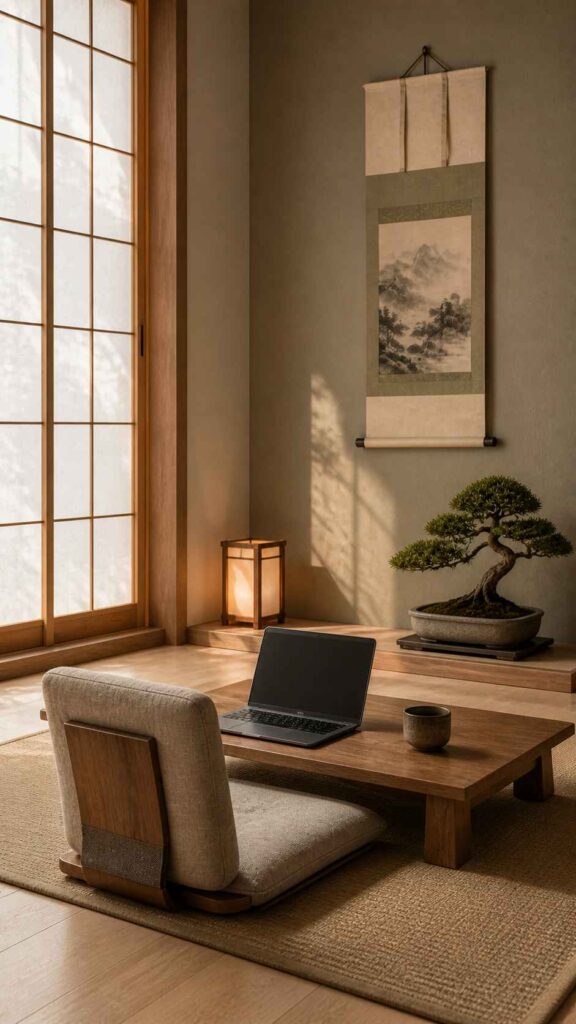
One of the most distinctively Japanese workspace ideas you can bring into a japandi home office is a low-level, floor-seated working arrangement. Drawing from centuries of traditional Japanese living that centres life at ground level, this setup creates a workspace that feels remarkably meditative and grounded. It’s not for everyone, but if you work short, focused sessions — creative sprints, journaling, reading, planning — there’s a particular clarity that comes from working close to the earth.
Practical Elements:
- Use a zaisu (legless floor chair with back support) to protect posture during longer sessions
- Choose a lacquered low wooden table at approximately 30–35 cm height for laptop use
- Layer a woven tatami mat beneath the setup to define the floor seating zone
- Keep the surrounding floor completely clear to amplify the meditative, open feeling
- Limit screen time in this setup — it’s ideal for creative thinking, not eight-hour deep dives
Description: There’s an undeniable ritual quality to sitting at floor level to work. In a japandi home office, the floor seating station is not about discomfort or self-deprivation — it’s about intentional engagement with your work. A zaisu floor chair keeps your spine supported while the low table positions your laptop at a natural, forward-leaning angle that promotes concentration. Add a small ceramic cup of green tea beside you, a single bonsai on the mat, and the act of opening your laptop becomes something close to ceremony.
Pro Tip: If you plan to use a floor seating station regularly, invest in a high-quality memory foam zafu cushion placed beneath the zaisu for added hip support. Stretch your hip flexors and hamstrings for three minutes before and after each floor seating session. This simple practice will allow you to sit comfortably for up to 90-minute focused work blocks without strain.
8. Japandi Palette: Warm Neutrals Done Right
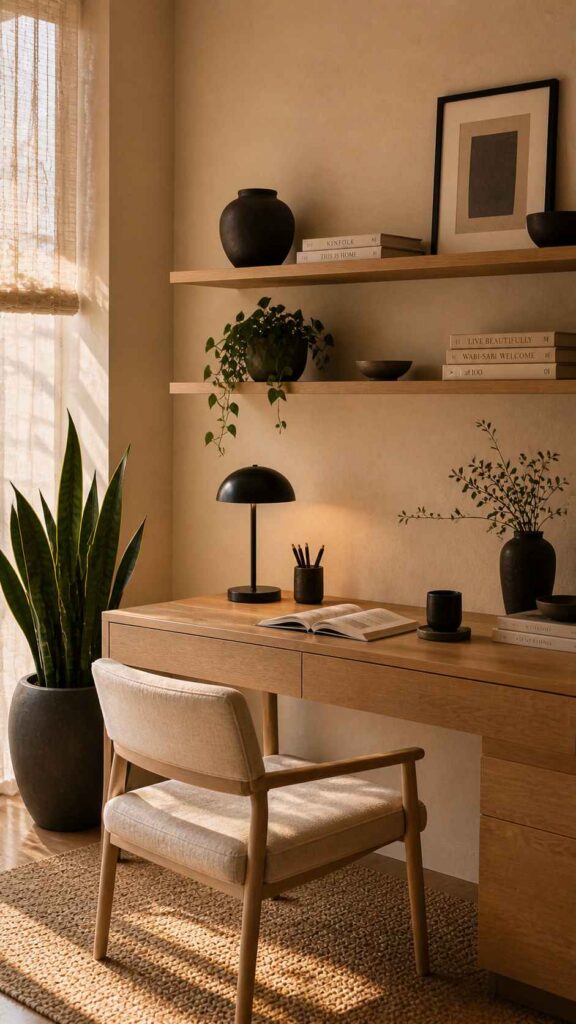
Colour is arguably the most invisible yet most powerful design decision in any japandi home office. Get it right and the room feels like a long, slow exhale. Get it wrong and even the most beautiful furniture sits in a space that feels either sterile and clinical or muddy and heavy. The secret lies in choosing warm neutrals with subtle organic undertones — creams that lean sandy, whites that lean ecru, greys that lean stone — and anchoring them with one or two deep, grounded contrast tones.
Practical Elements:
- Paint walls in warm ecru, pale clay, or soft greige — avoid pure titanium white
- Use Farrow & Ball Elephant’s Breath or Sherwin-Williams Accessible Beige as reliable references
- Introduce charcoal black or deep matte navy as visual anchors in small doses (lamp, pot, frame)
- Pick a maximum of two complementary wood tones for all furniture in the room
- Textiles (rug, curtains, chair) should read as a slightly lighter or warmer tone than the walls
Description: The warm neutral japandi palette is not about playing it safe — it’s about being deliberate. Every colour in the room should feel like it came from the same natural landscape: sand dunes, pale winter birch bark, river stones, dried grass. When you achieve that cohesion, the room reads as a unified breath rather than a collection of furniture pieces. Anchor the warmth with one deep-toned piece — a matte black ceramic lamp base, a deep charcoal picture frame, a forest green plant — and the entire palette comes into sharp, beautiful focus.
Pro Tip: Always test your wall paint colour on a large (at least A3-sized) card and live with it in the room for a full 24 hours before committing. Wall colours shift dramatically between morning natural light, afternoon sun, and evening warm lamp glow. What reads as perfect cream at noon can appear orange at sunset and almost grey by lamplight — and in a japandi home office, that consistency of calm warmth throughout the day is essential.
9. The Plant-as-Sculpture Approach
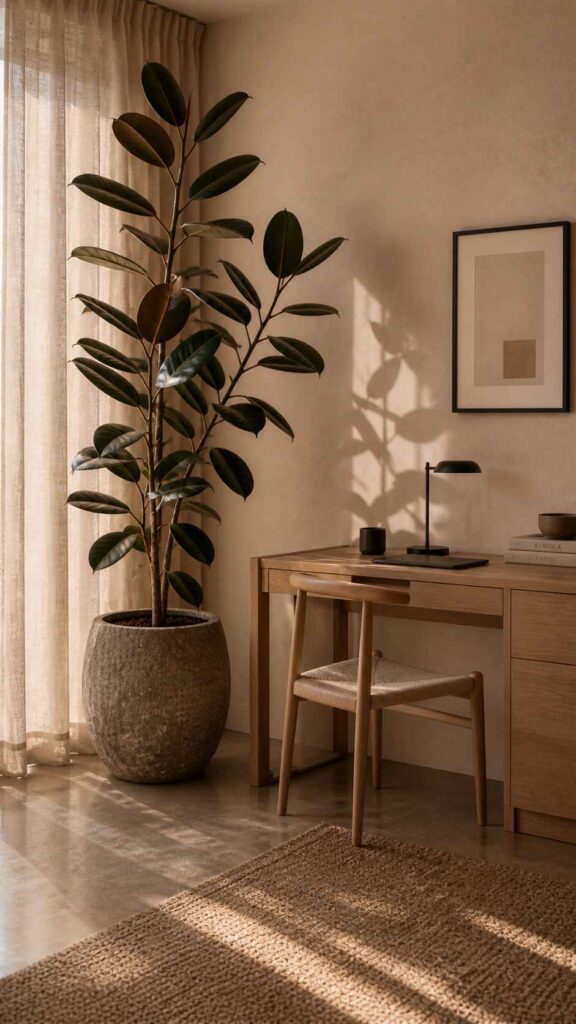
Plants in a japandi home office are not there to fill space — they’re there to make a statement. This is a crucial mindset shift from the popular “more plants equals more life” approach. In Japandi philosophy, a single architecturally striking plant in a beautiful vessel is infinitely more powerful than a shelf of fifteen small pots competing for visual attention. The plant becomes sculpture. The pot becomes art. And the room gains a living, breathing focal point.
Practical Elements:
- Choose architectural plants: snake plant, rubber plant, monstera, olive tree, or bonsai
- Select vessels that add textural contrast — rough stone, raw ceramic, or woven seagrass
- Position the plant where it can catch indirect natural light and be seen from the desk
- One large statement plant beats five small scattered ones every single time
- Avoid plastic pots — the inauthenticity of material immediately breaks the japandi spell
Description: The plant-as-sculpture philosophy transforms your japandi home office from a styled room into a living environment. A tall, dark-leafed rubber plant positioned in a corner beside a linen-curtained window does something no art print can replicate — it moves. It breathes. The shadows it casts change with the time of day. Placed thoughtfully, a single sculptural plant becomes the most dynamic element of the room, adding organic warmth, scale, and a gentle reminder that the natural world exists beyond your screen.
Pro Tip: Rotate your statement plant a quarter turn every two weeks so it grows symmetrically toward the light source. This keeps the plant’s architectural silhouette balanced and full, preventing the lopsided lean that often develops when plants are left stationary. A beautifully balanced plant always reads as more intentional and sculptural in a minimal japandi space.
10. Shoji Screen Room Divider Office
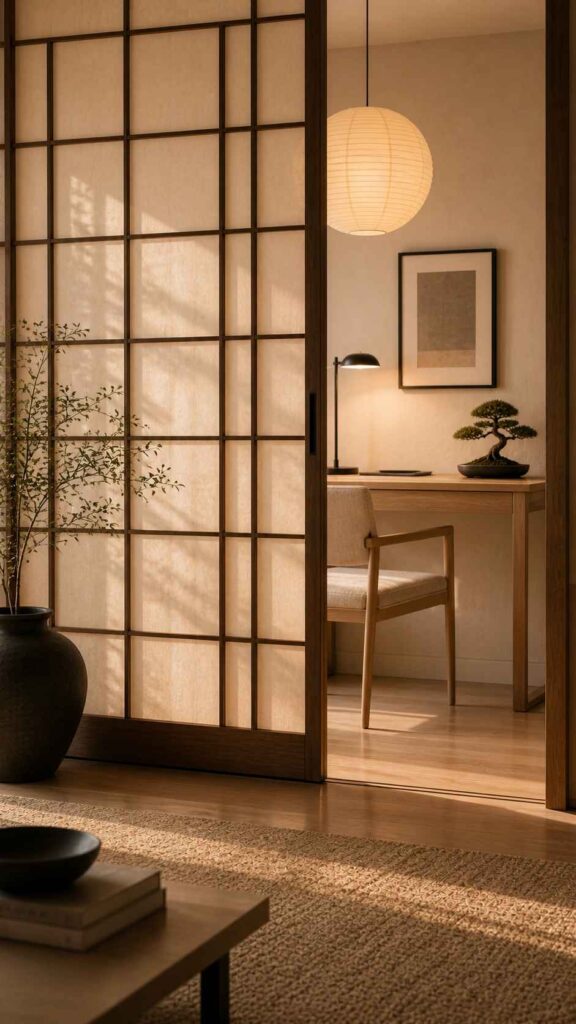
If your japandi home office shares a larger open-plan space — a living room, bedroom, or studio apartment — a shoji-inspired screen divider is the most elegant solution you’ll find. Traditionally used in Japanese architecture to define interior spaces without creating permanent walls, a shoji screen filters light while creating a soft, semi-transparent boundary around your workspace. It’s architectural, functional, and extraordinarily beautiful in that quiet, Japanese way.
Practical Elements:
- Choose a folding 4–6 panel shoji screen in dark walnut frame for rich Japandi contrast
- Position the screen perpendicular to your window to allow maximum light diffusion
- Use the shoji screen to block visual distractions from the living area while working
- Back-lighting a shoji screen with a warm floor lamp creates breathtaking ambience
- Opt for modern shoji screens with washi paper inserts over plastic-panel alternatives
Description: The shoji screen room divider gives your japandi home office a spatial identity without requiring a single structural change to your home. During work hours, it wraps your desk in a cocoon of diffused warm light and visual calm. During off hours, fold it flat against the wall and the workspace disappears, maintaining the clean aesthetic of the larger room. There’s a beautiful intentionality to this approach — your office literally materialises and dematerialises with the opening and closing of a screen, and that ritual act of setting up and closing down the workspace is deeply Japandi in spirit.
Pro Tip: Place a warm-toned floor lamp directly behind the shoji screen and position it at a slightly lower angle than standard standing height. When the lamp is switched on, the washi paper panels glow from within like a warm Japanese lantern, completely transforming the mood of the room. This is one of the most dramatic and beautiful lighting effects achievable in a home office without any electrical installation.
11. Ceramic and Handcrafted Desk Accessories
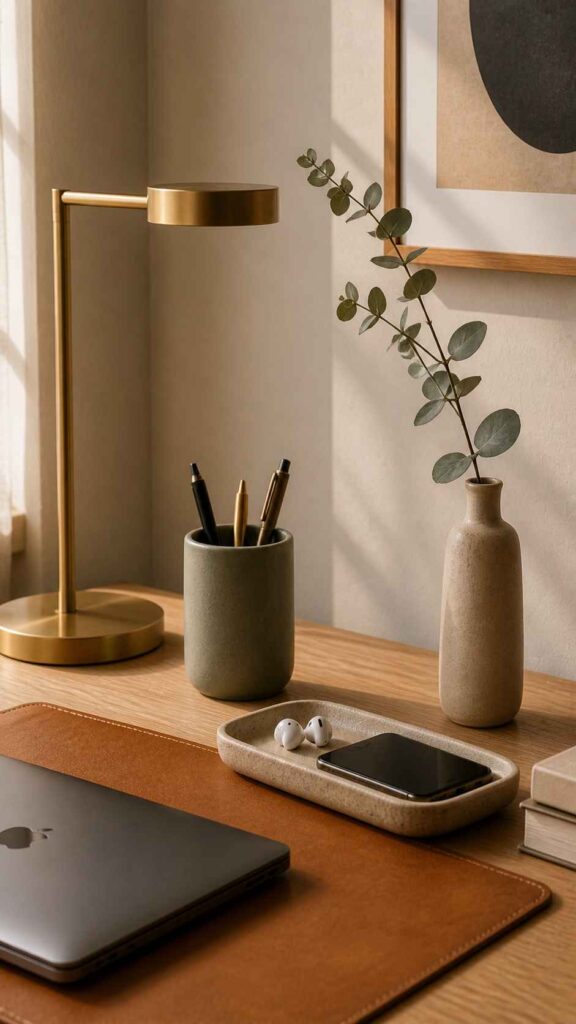
It’s the small things that either make or break the japandi home office experience. Specifically, it’s the accessories on your desk surface. A plastic pen cup, a branded mousepad, a glossy acrylic phone stand — these small objects introduce a visual dissonance that undermines an otherwise beautifully styled space. Replace them one by one with handcrafted ceramic or natural material alternatives, and the desk transforms from a workstation into a curated tableau.
Practical Elements:
- Replace plastic desk accessories with hand-thrown ceramic alternatives one piece at a time
- Use a full-grain leather or linen desk mat instead of synthetic rubber options
- Choose a ceramic bud vase for a single stem of dried botanicals (pampas, eucalyptus, cotton)
- Keep the desk surface to a maximum of five objects — lamp, mat, plant, pen holder, tray
- Look for “intentional imperfection” in ceramics — slight irregularities are the design feature
Description: The handcrafted ceramic desk accessory collection is wabi-sabi in its most practical form. A hand-thrown stoneware pen holder with uneven walls and a raw, unglazed base tells a story that a perfect plastic cup never could. That mild irregularity, that visible fingerprint left in the clay during throwing — that’s the humanity of the object. Placed on a warm white oak desk beside a leather mat and a single dried stem, the desk surface becomes a composition worth pausing to look at, even on the most stressful work mornings.
Pro Tip: When sourcing ceramic desk accessories for your japandi home office, prioritize buying directly from individual ceramic artists on Etsy or at local markets. Handmade pieces from independent makers tend to have a more authentic wabi-sabi quality than mass-produced “handmade-style” alternatives. The small premium is always worth it — and you support a craftsperson’s practice in the process.
12. Hidden Cable Management, Japandi Style
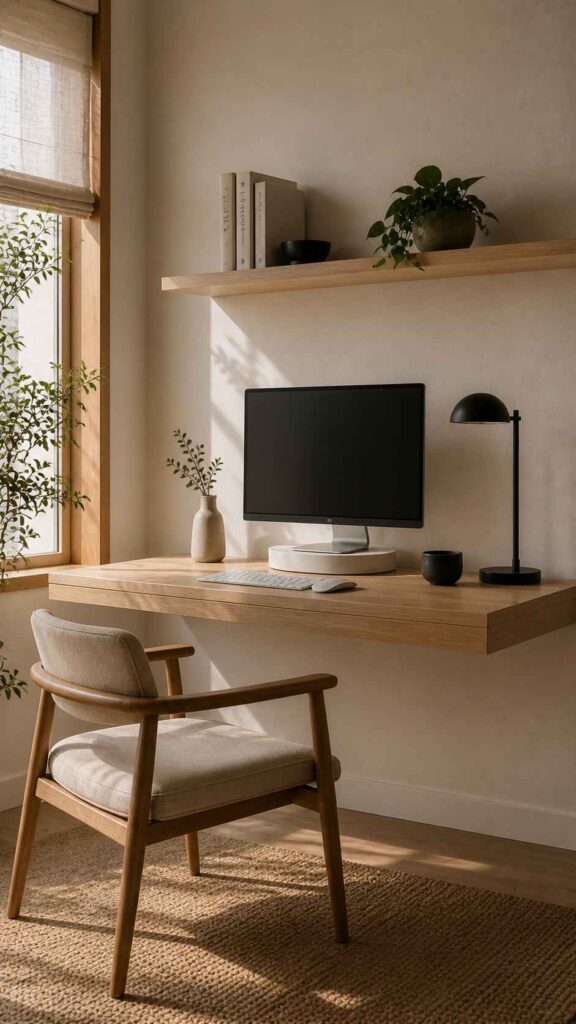
Here’s the uncomfortable truth about most “minimalist” home offices: they look great in photos but fall apart in real life the moment cables reappear. In a japandi home office, cable management is not optional — it’s a design discipline. Visible wires are the fastest way to visually undermine an otherwise beautiful space, and getting them permanently out of sight is one of the most satisfying transformations you can make in your workspace.
Practical Elements:
- Mount your power strip to the underside of the desk with heavy-duty double-sided tape
- Route horizontal desk cables through PVC J-channel raceways under the back desk edge
- Bundle all vertical cables into a single neoprene sleeve strapped to one desk leg
- Use wireless peripherals (keyboard, mouse, chargers) wherever possible to reduce wire count
- Cable clips in matching wood or matte black tones keep remaining wires flush against surfaces
Description: Achieving a visually cable-free japandi home office is a project, not a purchase — and it’s deeply worth the two-hour investment it requires. Start from the power source and work outward: strip mounted under the desk, cables channelled along the underside edge, a single bundled sleeve down the back of one leg. When you’re done, step back and look at the desk from the front. No wires. No mess. Just clean, warm wood and intentional objects. The mental relief that comes with a genuinely clutter-free workspace is immediate and lasting.
Pro Tip: Before routing any cables permanently, do a full “cable audit” — unplug everything and list every cable you actually use daily versus those just left plugged in out of habit. Most desks are carrying three to five unnecessary cables that are never used. Eliminating them entirely before management begins makes the routing job significantly simpler and the final result dramatically cleaner.
13. The Cozy Boucle Chair Corner
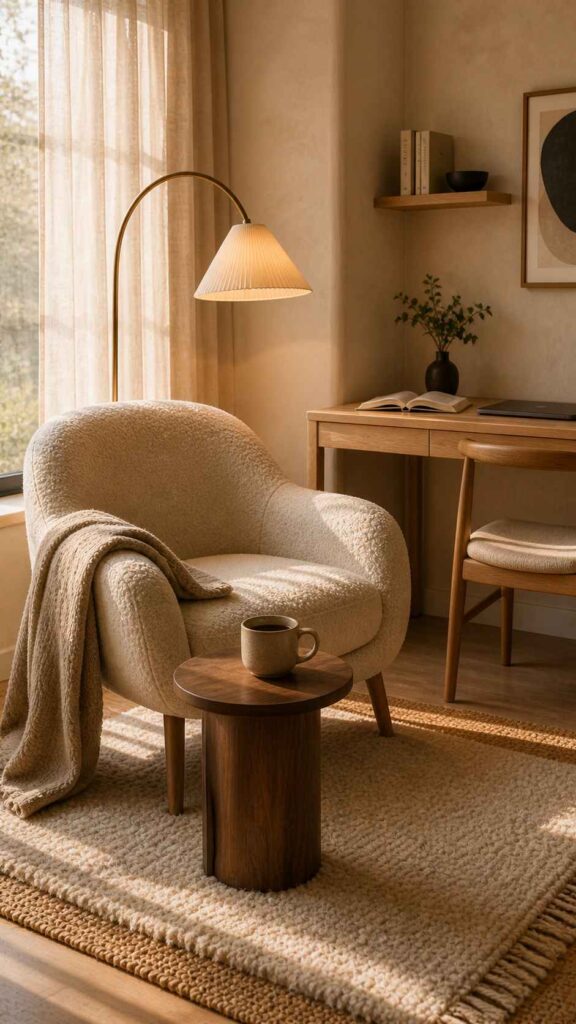
The chair in a japandi home office carries enormous visual weight — it’s the largest soft element in the room and the piece your eye naturally gravitates toward. A boucle upholstered chair in cream, oat, or warm stone takes the ergonomic necessity of seating and elevates it into a genuine design object. Boucle’s loopy, textured weave adds the tactile warmth and softness that keeps a japandi space from tipping into cold minimalism.
Practical Elements:
- Choose boucle chairs with natural wood (oak or walnut) legs rather than metal bases for warmth
- Opt for colours in the cream, oat, warm stone, or soft sage range for authentic japandi fit
- Place an arc floor lamp to the rear-side of the chair for warm, reading-friendly illumination
- Add a small walnut side table for a ceramic cup, notebook, and one small plant
- Layer a chunky knit throw over the armrest for a final tactile, wabi-sabi finishing touch
Description: The boucle chair corner in your japandi home office is your permission slip to slow down. Not every moment of work is high-intensity screen time — some of your best thinking happens when you step away from the desk, sink into a warm textured chair with a notebook, and let ideas come without forcing them. The boucle chair corner honours that reality. It acknowledges that a productive workspace serves the whole human, not just the task at hand, and that soft, warm, tactile comfort is not indulgence — it’s a productivity tool in itself.
Pro Tip: When choosing your boucle chair, avoid pure white upholstery in a working environment — it marks and discolours quickly under daily use. Instead, opt for a warm cream or oat-toned boucle with a slight beige or sandy undertone. This colour forgives a little more wear, photographs beautifully in natural light, and reads as warmer and more intentionally japandi than stark white ever will.
14. Jute Rug and Wood Grain Foundation
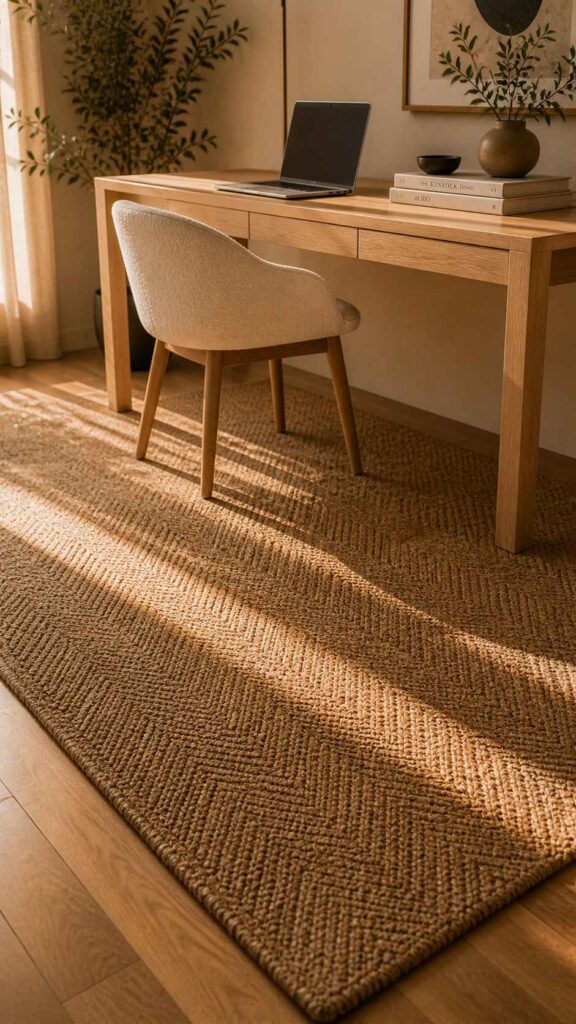
Before you place a single piece of furniture in your japandi home office, consider your floor. The combination of warm wood grain flooring layered with a natural jute rug creates a foundational texture palette that every piece of furniture above it harmonises with effortlessly. It’s the earth layer of your space — the ground from which the entire aesthetic grows — and getting it right makes everything placed on top look more intentional, more warm, and more beautifully Japandi.
Practical Elements:
- Choose a jute rug large enough so all furniture legs rest on the rug (not half on, half off)
- Herringbone or chunky flatweave jute patterns add visual texture without busy patterning
- Layer a thinner cream wool rug over jute for extra softness underfoot in colder climates
- Avoid synthetic fibre rugs — they photograph poorly and lack the authentic natural quality
- Anchor the rug with furniture weight rather than rug tape for a clean, rentable solution
Description: The jute rug and wood grain floor combination is the textural bedrock of the japandi home office. Where a plain polished concrete or cold tile floor can make a minimal room feel clinical, the layering of warm oak boards and a chunky natural jute rug creates an immediate sense of organic groundedness. The rough, honesty of jute fibres, the warm amber of oiled oak — together they set a tone for the entire room before a single desk item is styled. Everything placed above that foundation automatically reads as warmer and more considered.
Pro Tip: When placing your jute rug, choose a size that’s intentionally larger than you think you need. Interior designers consistently advise that rugs placed too small are the number one mistake in room styling. In a japandi home office, the rug should extend at least 30 cm beyond the legs of your desk chair in all directions. When in doubt, go one size up — the added visual weight grounds the room beautifully.
15. Washi Paper Lantern Lighting
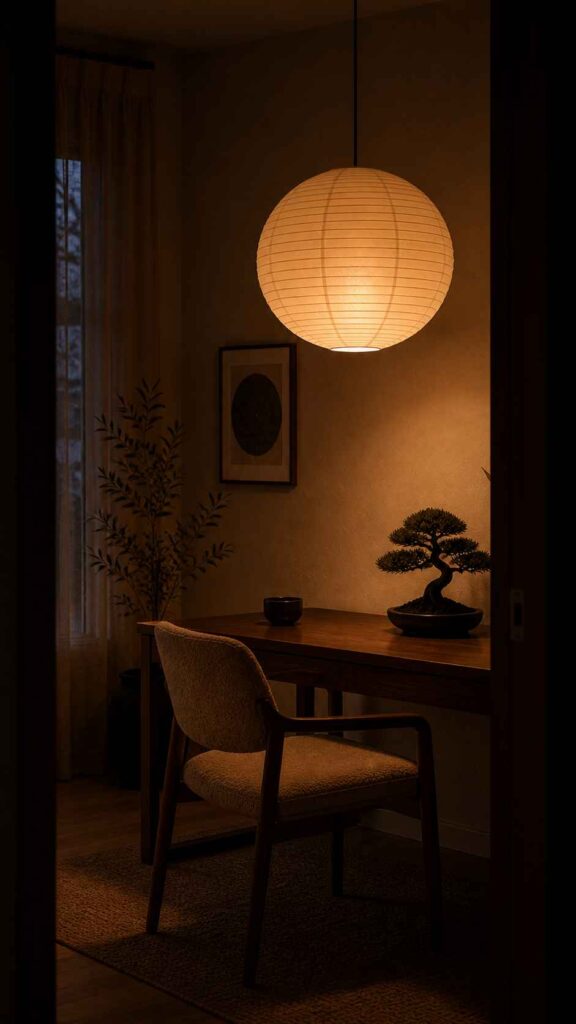
If there’s a single light fitting that is perfectly, unmistakably Japandi, it’s the washi paper lantern. Drawing on centuries of Japanese craft tradition, the washi paper pendant creates a quality of light that no other fixture can replicate — omnidirectional, shadow-softening, and impossibly warm. When hung above a desk or in the corner of a japandi home office, a washi lantern transforms the room the moment it’s switched on at dusk, wrapping the entire space in a luminous amber glow.
Practical Elements:
- Choose a Noguchi-inspired washi paper lantern in a spherical or elongated oval form
- Hang the pendant lower than standard — approximately 35–45 cm above the desk surface
- Use a 2700K Edison-style LED bulb inside for maximum warmth without heat risk
- Pair the washi lantern with dimmer switch control for full mood range from bright to atmospheric
- Ensure the pendant cable is fabric-wrapped in cream or natural linen for visual consistency
Description: The washi paper lantern is the heart of japandi lighting philosophy made physical. Unlike a bare bulb or a glass pendant that concentrates light into a hot, glaring point, washi paper disperses light in every direction simultaneously, eliminating harsh shadows and filling the room with a warm, even glow that feels closer to candlelight than ceiling fixture. Hang one above your japandi home office desk at dusk, dim it to roughly 60%, and watch the room completely transform from workspace to sanctuary in seconds. It is, quite simply, irreplaceable.
Pro Tip: If you’re concerned about washi paper lanterns looking too casual or insubstantial, look specifically for Akari-series Noguchi lamps or high-quality Japanese washi pendants with wooden ribbing. These structured versions maintain the beautiful light quality of traditional washi while carrying enough visual weight and sculptural elegance to anchor a sophisticated, design-led japandi home office confidently.
16. The Dual-Tone Wood Contrast Workspace
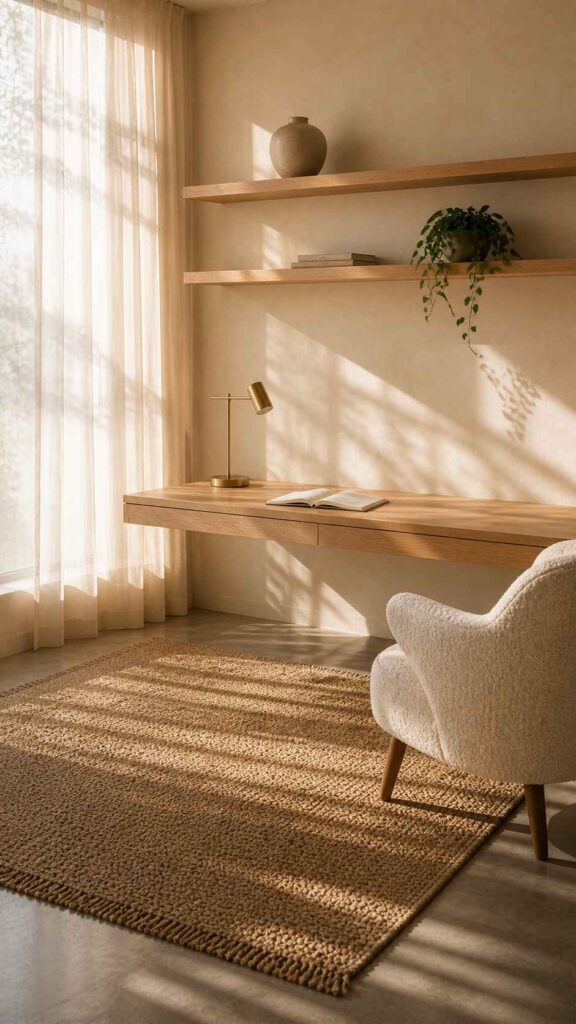
One of the most sophisticated expressions of japandi design is the intentional pairing of two complementary wood tones in a single workspace. Where many minimalist interiors play it safe with a single wood throughout, the dual-tone approach introduces a layer of depth and visual interest that keeps the room from feeling flat. The key is harmony — pairing woods that share the same warmth temperature (both warm, never one warm and one cool) while contrasting in lightness or depth of tone.
Practical Elements:
- Pair light white oak or ash with dark walnut for the classic high-contrast japandi dual tone
- Assign roles to each tone: lighter wood for the primary desk surface, darker for storage/shelving
- Introduce a single matte metal element (lamp, handle, bracket) to bridge the two wood tones
- Keep both wood tones in the warm temperature range — avoid mixing warm and cool-toned woods
- Limit to exactly two wood tones in the entire room to maintain minimalist discipline
Description: The dual-tone wood contrast workspace is the japandi home office at its most artistically deliberate. The light oak desk surface catches and reflects morning sunlight, appearing almost golden as it illuminates the grain. The deeper walnut shelving behind it anchors the wall, grounding the room with a gravity that prevents the overall palette from floating away into blandness. Matte black hardware bridges the two tones effortlessly. Together, the three elements — light wood, dark wood, matte black — create a palette so cohesive and warm that the room feels designed rather than merely assembled.
Pro Tip: Before committing to your dual wood tone combination, bring physical samples of both wood species into your office space and hold them side by side in the actual lighting conditions of the room. Wood samples always look different under gallery lighting at a furniture showroom than they do under your specific window light and warm lamp setup. Confirm the harmony in your specific environment before purchasing.
17. The Fully Decluttered Deep Work Sanctuary
Ultimately, the most powerful japandi home office idea isn’t about what you add — it’s about what you remove. The fully decluttered deep work sanctuary takes every principle of Japandi philosophy and applies it to one final, purposeful edit of your workspace. No decorative objects that don’t earn their place. No technology that isn’t daily-use essential. No surface clutter that interrupts the visual quiet. What remains is a room that, the moment you walk into it, tells your brain: it’s time to think.
Practical Elements:
- Remove everything from all surfaces and replace only what is essential or genuinely beautiful
- Apply the strict 80/20 rule: 80% of items hidden in storage, 20% visible on open surfaces
- Use cable management to achieve a visually zero-wire desk surface aesthetic
- Store charging devices, documents, and technology accessories in closed baskets or cabinets
- Revisit and declutter the workspace monthly — minimalism is maintenance, not a one-time act
Description: The fully decluttered japandi home office deep work sanctuary is what this entire aesthetic has been building toward. It’s the room where every decision — the warm wall colour, the white oak desk, the washi lantern, the single sculptural plant — compounds into a space that actively supports your best thinking. There’s nothing in the visual field to distract or overwhelm. The room is quiet in a way that goes beyond simply not making sound. It’s visually quiet. Cognitively quiet. And in that quiet, your most focused, creative, and productive work becomes not just possible — it becomes almost inevitable.
Pro Tip: Schedule a fifteen-minute “reset ritual” at the end of every workday where you restore the desk to its base state: clear surface, lamp off, notebook closed, chair pushed in neatly. This closing ritual reinforces the psychological boundary between work and rest, deepens your appreciation for the beauty of the empty desk, and ensures you walk into a visually calm, motivating workspace every single morning without fail.
Conclusion:
Creating your ideal japandi home office is not about chasing a Pinterest aesthetic — it’s about building a space that genuinely supports how you think, create, and recover. Every idea in this list — from the white oak floating desk to the fully decluttered deep work sanctuary — shares the same underlying philosophy: remove what doesn’t serve you, and what remains becomes extraordinary. You don’t need to implement all 17 ideas at once. Pick one. Clear your desk surface completely. Swap one plastic accessory for a ceramic one. Install a washi lantern. Then step back and feel the difference. The calm you’ve been searching for in your workspace was never about adding more — it was always about choosing better. Start today, and build your haven one intentional decision at a time.